
Guide
Essential 3D Printing Tools and Accessories
A printer gets you a rough part. Everything that makes it look finished happens afterwards, at the bench.
These are the tools I use on almost every prop and miniature, what each one is genuinely good at, and, just as usefully, the jobs people expect them to do that they cannot.
Support Removal and Edge Cleanup
Flush cutters take supports off without tearing the surface: cut proud of the part first, then deal with the remaining nub separately rather than trying to shear it flush in one go. A deburring tool clears the raised lip left by an elephant’s foot or a support scar in a single pass, and it squares an edge far faster than sanding will.
On resin parts, work gently. Cured resin chips rather than curls, so take shallow passes and support the piece in your hand instead of levering against it.
Sanding and Priming
Sand in order and do not skip grits. Start at 120 to knock down layer lines and support scars, move to 220 to remove the scratches the 120 left, then 320 or 400 before primer. Resin parts are better wet-sanded: it keeps the dust out of the air and stops the paper clogging.
Then let filler primer do the rest of the work. Two or three light coats fill what remains of the layer lines far more evenly than more sanding will, and any flaw still visible under grey primer is a flaw the paint will show.
What a Heat Gun Is and Is Not For
A heat gun is genuinely useful for reflowing a warped part back into shape, softening a piece so it can be curved to fit a body, and burning stringing off a print in seconds.
It is not a reliable way to smooth layer lines on PLA. In practice thin walls and fine details slump before the surface ever goes glassy, and the part loses dimensional accuracy on the way. Solvent vapour smoothing works on ABS and ASA, not on PLA. For PLA and resin the answer is mechanical every time: sand, fill, prime.
Adhesives That Actually Hold
Match the glue to the load. Cyanoacrylate gel is the right default for small parts and quick alignment. It grabs fast, fills a small gap and will not run down the print, but the cured bond is brittle and it gives up under heat.
For anything structural or load-bearing on a large multi-part print, use two-part epoxy: slower and messier, considerably stronger, and it fills the gaps between imperfect mating faces instead of just wetting them. Keep E6000 for joints that need to flex, or for bonding prints to fabric and foam. It is a flexible adhesive, not a structural one.
Magnets for Parts That Come Apart
Magnets are what make a large prop transportable. Design the pocket into the model from the start, with 1–2 mm of wall around it and a press fit, and mark the polarity on every magnet with a marker before it goes anywhere near a print. One reversed magnet in a glued pocket means reprinting the part.
Fit them after printing with cyanoacrylate or epoxy, or pause the print and drop them into a side-facing pocket where the nozzle cannot catch and drag one. Keep them away from heat: neodymium begins losing strength above roughly 80 °C, so no hot glue and no heat gun near a finished pocket.
Safety Equipment
Nitrile gloves for resin, alcohol and adhesives. Safety glasses any time something is being cut, sanded or snapped. A half-face respirator with organic-vapour/P100 cartridges for resin handling and spray painting, with the caveat that it only protects you with a clean seal against bare skin, and that cartridges are consumables with a service life rather than permanent parts of the mask.
Ventilation comes first and the respirator second, not the other way around. A silicone mat under the resin work area is worth the few dollars, because cured drips peel straight off it.
Recommended Gear
Our Picks

Pros
- Squares up an edge in one pass instead of five minutes of sanding
- Works on both FDM and resin parts
- Replaceable blades, and the swivel head follows curves
Cons
- Easy to gouge a surface until you learn to keep the blade shallow
- Cured resin chips rather than shaving cleanly, so go light on brittle parts

Pros
- Detail triangle reaches into corners a sanding block cannot
- Cordless, so it goes to wherever the part is clamped
- Takes hook-and-loop sheets in every grit you need
Cons
- Aggressive on thin PLA walls: lean on it and it will heat and smear the plastic
- Sold tool-only: battery and charger are a separate purchase
- Not suitable for wet sanding resin

Pros
- Strong enough that a helmet or armour section stays put while being worn
- Bar shape resists rotating in its pocket the way discs tend to
- Cheap enough that you start designing them into everything
Cons
- Pockets have to be designed in advance; retrofitting means drilling
- A polarity mistake is unforgiving once the magnet is glued in
- Lose strength above roughly 80 °C, and they will grab build plates and steel tools

Pros
- Bayonet cartridges cover resin fumes, solvents and spray paint on one mask
- Silicone facepiece stays comfortable through a long session
- Every part is replaceable, so the facepiece outlasts many sets of cartridges
Cons
- Needs a clean seal; facial hair on the sealing surface defeats it
- Sizing matters; a half facepiece that does not fit does not protect
- Not a substitute for ventilating the room

Pros
- Organic vapour plus P100 particulate in one cartridge, the correct pairing for resin and paint
- Fits the 7502 and the rest of the 3M 6000/6500/7500 bayonet series
- Having spares on the shelf is what makes you actually change them on time
Cons
- Service life is limited and begins once the packet is opened
- Not rated for every chemical, so check 3M’s selection guide for anything unusual
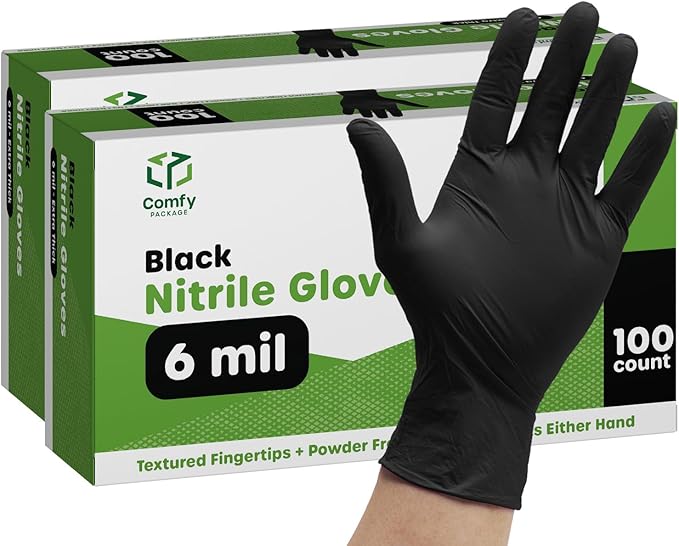
Pros
- 6 mil is thick enough to survive resin cleanup without tearing
- Handles resin, isopropyl alcohol and adhesives
- Bulk box, so swapping gloves is never a decision you have to think about
Cons
- Single use: resin-contaminated gloves need UV curing before disposal
- Nitrile specifically; latex is not a substitute for resin work